

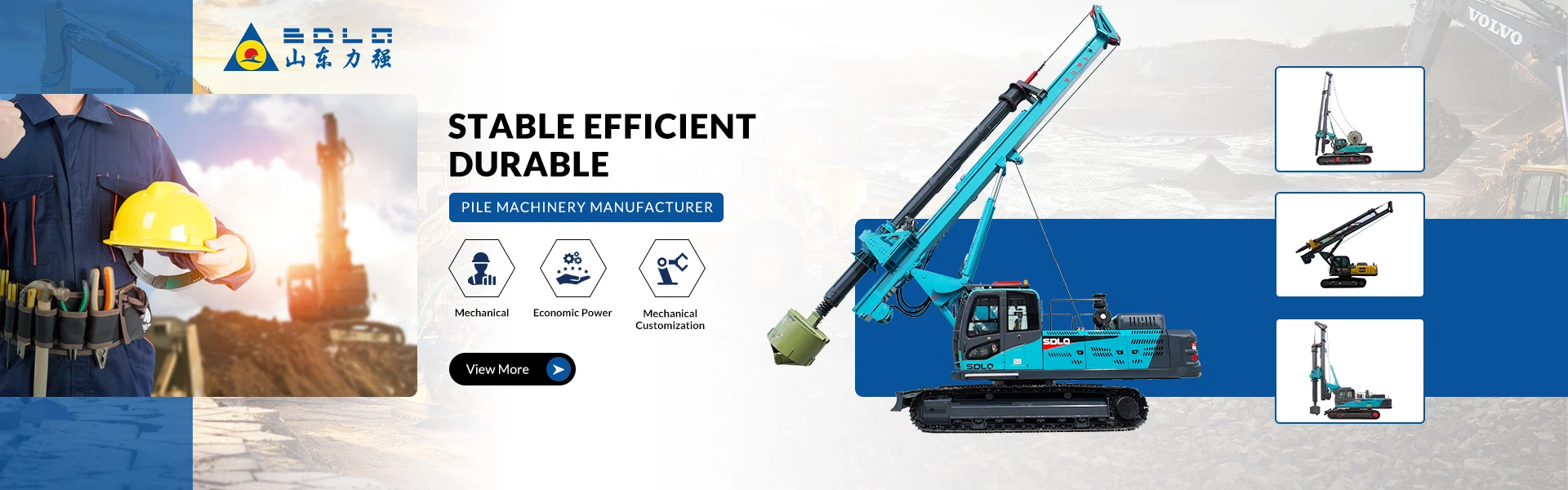
I. Definition of Rotary Drilling Rigs and Piling Machines#geological drilling machine#
A rotary drilling rig, also commonly known as a rotary drilling machine or piling machine, is a multi-functional drilling machine. It can operate on various geological formations and is renowned for its rapid hole-forming speed, environmental friendliness, and excellent maneuverability. Whether using a short auger for dry excavation or a rotary drill bit for wet excavation with mud walls, the rotary drilling rig can handle it with ease. Furthermore, after breaking up hard strata with a hammer drill, it can also perform borehole excavation. When combined with an enlarger drill bit, it can enlarge the hole at the bottom, meeting different construction needs. Its multi-layer telescopic drill rod design reduces drilling auxiliary time, lowers labor intensity, and avoids mud circulation and slag removal, saving costs and making it ideal for foundation construction in urban development.
II. Construction Principle of Rotary Drilling Piles
The hole-forming process of rotary drilling rigs in bored pile construction is unique and differs from conventional pile foundations. It uses static mud wall technology, drilling by removing soil through the drill bucket. This process eliminates the need for flushing media circulation. However, during the drilling process, in order to ensureTo maintain the stability of the borehole wall, high-quality mud (stabilizing fluid) needs to be injected into the borehole.

Rotary drilling rigs possess the ability to rotate entirely in place during bored pile construction. When drilling for soil removal, they primarily rely on the weight of the drill rod and drill bit to cut into the soil layer. As the bucket rotates, the inclined bucket teeth cut off soil clumps and push them into the bucket, thus completing the soil removal task. If encountering hard soil layers, the weight of the drill rod may not be sufficient for the bucket teeth to cut in. In this case, additional pressure can be applied to the drill rod using a hydraulic cylinder to ensure the bucket teeth can successfully cut in and complete the soil removal. Once the bucket is full, the crane quickly lifts the drill rod and bucket to the ground. By operating a switch on the bucket, the bottom door is opened, allowing the soil inside the bucket to be automatically discharged under its own weight. Subsequently, the bucket door is closed, and the rig rotates back into the hole, ready for the next round of excavation.

III. Four Main Methods of Rotary Drilling Rigs in Pile Driving
1. Individual Driving Method: This method involves driving piles one by one, starting from one corner of the wall to ensure the uniformity of the overall project. This method is simple to implement, requires no auxiliary tools, and is easy to operate. However, it should be noted that this method is prone to pile tilting due to changes in soil conditions, requiring careful operation.#geological drilling machine#

2. The screen-like driving method involves arranging approximately twenty sheet piles in an orderly fashion and inserting them one by one into a guide frame to form a screen-like structure. This method is implemented in batches to reduce tilting errors, effectively prevent construction obstacles caused by tilting, and optimize the closure effect. However, the overall construction difficulty is relatively high, requiring special attention to construction stability and worker safety.

3. During construction, it is crucial to ensure the accuracy of the driving position and direction to maximize the effectiveness of Larssen sheet piles. This is not only essential for ensuring overall construction quality but also a critical factor in guaranteeing construction safety. While various methods can be used to adjust the angles and closures of sheet piles, safety is always the primary consideration. Therefore, during operations, it is imperative to maintain high vigilance and closely monitor the surrounding environment, especially avoiding pipelines and high-voltage cables, to ensure safe construction.

4. During the installation of Larssen sheet piles, appropriate installation equipment must be selected based on different geographical locations and installation methods. This not only ensures the accuracy of installation but also effectively guarantees construction safety. Therefore, when selecting equipment, it is essential to closely consider the actual installation requirements to ensure a safe and efficient installation process.

V. Pile Foundation Inspection and Testing
After the rotary drilling is completed, the bearing stratum at the pile tip should be inspected immediately. This step is crucial because it involves confirming the presence of adverse geological conditions such as cavities, fracture zones, and weak interlayers within a depth of 3D (D is the pile tip diameter) or 5m below the pile. Only through this inspection can the stability and safety of the pile foundation be ensured.
After the pile foundation is completed, to further ensure construction quality, sampling tests should be conducted on the single pile bearing capacity and pile integrity of the engineering piles. These tests not only provide comprehensive control over the pile foundation quality but also effectively supervise the construction process.
Furthermore, attention must be paid to the timing of the tests. When using the sonic logging method, the concrete strength of the pile under test should be at least 70% of the design strength and not less than 15MPa to ensure the accuracy of the test results. Simultaneously, to ensure smooth construction, it is recommended to conduct pile integrity testing first, followed by bearing capacity testing, after construction, thus providing strong support for subsequent construction.

Many of these cities possess unique geographical and climatic characteristics, therefore, the impact of these factors on construction must be fully considered when conducting pile foundation inspection and testing. Furthermore, pile foundation construction standards may vary across different regions; therefore, in practice, it is essential to adhere to local construction specifications and requirements to ensure the stability and safety of the pile foundation.#geological drilling machine#


