

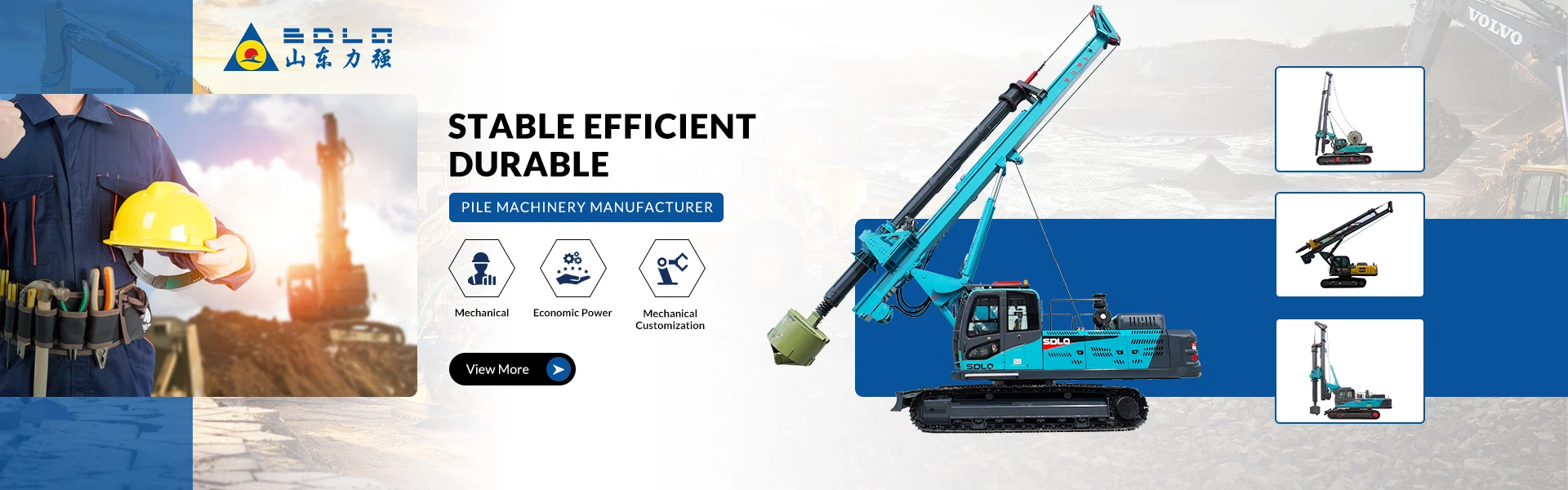
Rotary drilling rigs offer significant advantages in foundation engineering, primarily in the following aspects:#mobile rigs#
I. High Efficiency and Shortened Construction Period
High Drilling Efficiency
Rotary drilling rigs utilize a power head to drive the drill rod rotation, coupled with a telescopic drill rod design, enabling rapid soil extraction and unloading cycles. For example, in cohesive soil layers, using a long drill barrel, the drilling depth can reach 15-20 meters per hour, 3-5 times that of traditional impact drilling rigs.
Superior Hole Quality
Through a precise computer operating system and hydraulic control, rotary drilling rigs can achieve hole accuracy with a verticality deviation of less than 0.5%, and the thickness of sediment at the bottom of the hole can be controlled within 5 cm, significantly improving the bearing capacity of the pile foundation.
Multi-functional and Highly Adaptable
By changing drill bits (such as short auger bits, core drill bits, and grab drill bits), they can adapt to various geological conditions, including sandy soil, cohesive soil, silty soil, strongly weathered sandstone, gravel layers, and even hard rock layers, reducing the frequency of equipment replacement.
II. High Automation, Reduced Labor Intensity
Fully Hydraulic Self-Propelled Design#mobile rigs#
The rotary drilling rig uses a tracked chassis and is equipped with a hydraulic system, allowing it to move and align itself without the need for cranes or other auxiliary equipment. For example, when the site's load-bearing capacity meets requirements, the equipment can independently complete relocation and positioning, saving labor and time.
Intelligent Control System
Through a computer operating system, drilling parameters (such as torque, speed, and pressure) can be monitored in real time, and the drilling speed can be automatically adjusted to avoid human error. Simultaneously, the telescopic drill rod design reduces auxiliary time spent adding drill rods, increasing time utilization by over 30%.
Low Labor Intensity
The construction process eliminates the need for manual cleaning of drill cuttings or assembly of drill rods. Operators only need to monitor equipment operation, reducing labor intensity by over 70% compared to traditional methods.
III. Environmentally Friendly and Energy-Saving, Reduced Pollution
Low Mud Consumption
The amount of mud used in rotary drilling is only 1/10 to 1/20 of that used in forward and reverse circulation drilling, resulting in a cleaner construction site and reducing mud treatment costs by over 50%.
Low Vibration and Noise
The rotary drilling rig operates at a noise level below 85 decibels, with minimal vibration and minimal impact on the surrounding environment, making it particularly suitable for urban residential areas or areas with high environmental protection requirements.
Energy-Saving Design
Powered by a diesel engine, it eliminates the need for an external power source, avoiding the costs associated with cable transportation and protection. Furthermore, the engine's high efficiency reduces fuel consumption by 20%-30% compared to traditional equipment.

IV. Economic and Management Advantages#mobile rigs#
**Fast Return on Initial Investment**
Although rotary drilling rigs have a higher unit price, their high efficiency can shorten the construction period by 30%-50%, and reduce labor and machinery maintenance costs by more than 40%.
**Low Management Costs**
The equipment has a high degree of automation, reducing the number of operators and support staff by more than 50%, while also having low power consumption, simplifying on-site management processes.
**High Adaptability, Reduced Equipment Idle Time**
Rotary drilling rigs can be widely used in building construction, high-speed rail, highways, bridges, power tower foundations, port terminals, and other fields. The equipment has a high utilization rate and a short investment payback period.
V. Technical Advantages and Construction Flexibility
**Diverse Drilling Methods**
Supports various drilling techniques such as dry drilling, clear water drilling, and mud-wall drilling, allowing for flexible selection based on geological conditions. For example, dry drilling can be used in well-cohesive soil and rock layers, eliminating the need for mud treatment and further reducing costs.
Easy to move and quick to relocate
The tracked chassis design allows the equipment to move autonomously in confined spaces, reducing relocation time to one-third that of traditional equipment.
High single-pile bearing capacity
The rotary drilling rig produces a rough borehole wall, resulting in a tight bond between the pile and the soil. This increases the single-pile bearing capacity by 10%-20% compared to bored cast-in-place piles, making it suitable for projects with high bearing capacity requirements.#mobile rigs#


