

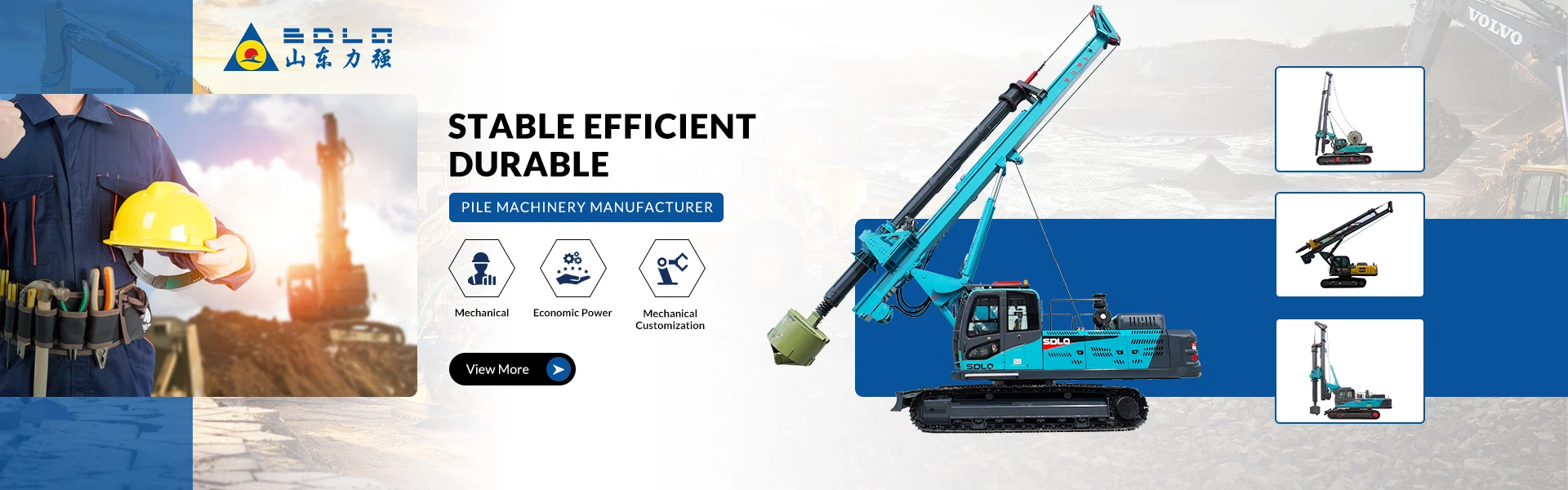
There are various types of bridge pile foundation drivers, including diesel hammers, static pressure pile drivers, and vibratory pile drivers. When selecting a suitable type, factors such as construction conditions, pile type, and pile length should be considered.
Bridge pile foundations are a critical component of bridge construction, and their quality is directly related to the overall stability and safety of the bridge. In bridge pile foundation construction, pile drivers are essential equipment, and their selection and use are crucial to construction efficiency and quality. This article will introduce the types of bridge pile foundation drivers and selection strategies to help readers better understand and master these technologies.
I. Types of Bridge Pile Foundation Pile Drivers
1. Diesel Hammer Pile Driver: Powered by diesel, diesel hammer pile drivers drive piles into the soil through hammering. These pile drivers offer strong impact and penetration, making them suitable for pile foundation construction in various geological conditions. However, diesel hammer pile drivers are noisy and vibrate strongly, potentially impacting the surrounding environment.
2. Static Pressure Pile Driver: Static pressure pile drivers use static pressure to drive piles into the soil, offering advantages such as low noise, low vibration, and minimal impact on the surrounding environment. Meanwhile, static pile drivers are suitable for various pile types and offer high construction efficiency. However, static pile drivers have strict requirements for geological conditions and are not suitable for hard soil or rock formations.
3. Vibratory pile drivers: Vibratory pile drivers use the excitation force generated by a vibrator to sink the pile into the soil. Vibratory pile drivers offer advantages such as high construction speed and strong adaptability, making them particularly suitable for pile foundation construction in sandy and soft soils. However, vibratory pile drivers have certain requirements for pile quality and dimensions, and their use may cause some disturbance to the surrounding environment.
II. Strategies for Selecting a Piling Driver for Bridge Foundations
1. Selection Based on Geological Conditions: Geological conditions are a key factor in selecting the type of pile driver. For easily penetrable formations such as soft soil and sand, diesel hammer pile drivers or vibratory pile drivers are suitable; for harder soil or rock formations, static pile drivers are preferred.
2. Considering Construction Efficiency and Cost: Different types of pile drivers differ in terms of construction efficiency and cost. When selecting a pile driver, it's important to comprehensively consider factors such as construction time, equipment costs, and maintenance expenses to select the most cost-effective solution.
3. Environmental considerations: With increasing environmental awareness, the trend is towards low-noise, low-vibration pile drivers. When selecting a pile driver, environmental considerations should be fully considered to minimize impact on the surrounding environment.
4. Consider pile foundation type and size: Pile foundation type and size are also important factors in selecting a pile driver. Different types of pile foundations require different types of pile drivers, so the selection process should be tailored to meet specific needs.
In summary, the selection of a pile driver for bridge foundations requires comprehensive consideration of factors such as geological conditions, construction efficiency and cost, environmental requirements, and pile foundation type and size. Only by fully understanding the characteristics and applicable scenarios of various pile drivers can the most appropriate one be selected to ensure efficient bridge foundation construction.


