

What's the difference between an excavator auger drill, a rotary drilling rig, and a down-the-hole drill? Many customers call to inquire about auger drills, immediately asking for a 30-meter auger drill. Actually, everyone misunderstands the function of an auger drill; drilling 20-30 meters is the job of a rotary drilling rig. Some customers also ask how to drill in rock; actually, down-the-hole drills are used for drilling in rock.#hydraulic rig machine#

Excavator auger drills are characterized by their flexibility and speed in drilling, making them suitable for various applications such as utility pole drilling, tree planting, and photovoltaic pre-drilling. For these applications requiring rapid drilling, choose Jining Intelligent Manufacturing Engineering Grand View. Auger drills are easy to install; simply connect the hydraulic breaker to the piping and they're ready to use. They allow for quick switching between excavator attachments like buckets and hydraulic breakers, saving time and offering versatility. Rotary drilling rigs, on the other hand, are only suitable for drilling holes.
Excavator auger drills are lightweight and flexible, requiring minimal space and easily portable. Drill rod diameters range from 10mm to 1500mm, allowing for drilling depths up to 10 meters. An excavator auger drill consists of a power head, drill rod, and bracket, and can be mounted on excavators, loaders, and other hydraulically driven equipment. The excavator auger drill boasts powerful performance, completing a 50cm diameter, 2-meter deep pit in approximately one minute. This is over 100 times more efficient than traditional manual digging and 5-7 times more efficient than rear-mounted digging equipment. Operation is simple.
The excavator auger drill integrates driving and operation, allowing 1-2 operators to easily complete various pit digging and drilling tasks, demonstrating strong adaptability. Utilizing a loader or excavator as its platform, this type of equipment possesses strong off-road capabilities, adapting well to complex terrains such as hills and mountains. It can operate on most soil types, including loess, clay, gravelly soil, weathered rock, frozen soil, construction waste, sand, and domestic waste layers.

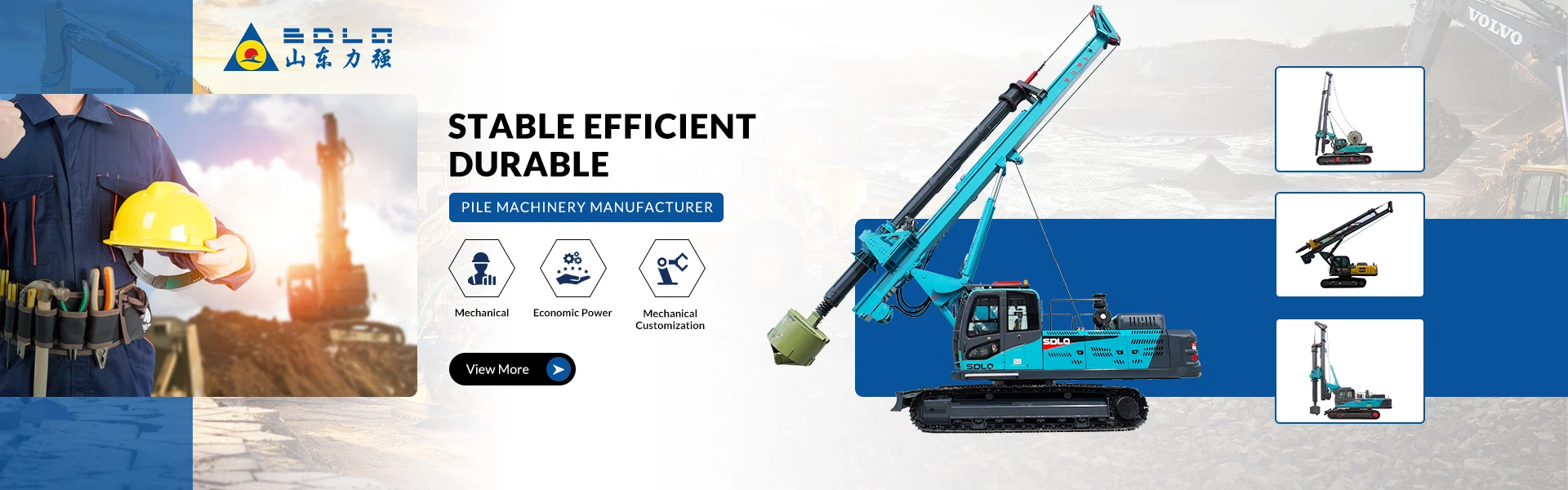
Rotary drilling rigs are construction machines suitable for hole-forming operations in building foundation engineering. They are mainly suitable for construction in soil layers such as sand, cohesive soil, and silty soil, and are widely used in various foundation constructions such as cast-in-place piles, continuous walls, and foundation reinforcement. The rated power of rotary drilling rigs is generally 125-450kW, the power output torque is 120-400kN·m, the maximum hole diameter can reach 1.5-4m, and the maximum hole depth is 60-90m, which can meet the requirements of various large-scale foundation constructions.#hydraulic rig machine#
Down-the-hole (DH) drilling equipment is the DH rig. The essence of DH drilling is to submerge the impactor into the hole during the drilling process to reduce energy loss caused by the impact energy transmitted through the drill rod, thereby minimizing the impact of hole depth on drilling efficiency. DH rigs can be broadly classified into underground and open-pit types based on their application location. Underground DH rigs can be further divided into self-propelled and non-self-propelled types based on whether they have a traveling mechanism. Based on the hole diameter, DH rigs can also be classified into light-duty DH rigs (80-100mm), medium-duty DH rigs (130-180mm), and heavy-duty DH rigs (180-250mm). #hydraulic rig machine#


