

Rotary Drilling Rig Selection Guide: Small Pile vs. Large Pile – Which Model to Choose?
Whatever your project needs, we're here to provide the right rotary drilling rig!
01 Key Considerations for Rotary Drilling Rig Selection#drilling rig manufacturer#
Selecting the right rotary drilling rig is a crucial step in any project. Different types of pile holes require different models of rotary drilling rigs. This article will delve into several key factors influencing selection, including pile length, pile diameter, geological conditions, and specific pile type requirements. We will also detail variations in pile hole size and depth, as well as the complexity and hardness of the geological formations. Through this article, you will gain a clearer understanding of how to choose the appropriate rotary drilling rig model based on your specific project needs.
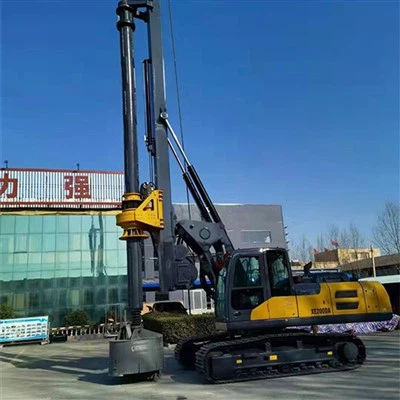
❒ Small Pile Drilling Rigs Suitable for Small Pile Drilling
In engineering projects, small piles typically require small rotary drilling rigs, such as models 130, 150, and 160. This is because the length and diameter of the drill rod are limited, making these models the best choice for handling small piles.
1. The 550 model rotary drilling rig has a pile hole depth limited to within 3.5 meters.
2. Drilling for small piles is affected by the length and diameter of the drill rod, while drilling for large piles is limited by the machine model itself. The distance between the center of the drill rod and the track, i.e., the reasonable dimension, determines the size of the drill bit that can be installed. Otherwise, even if it can be installed with difficulty, it cannot work properly because the rotation will be interfered with.
3. In the building construction field, common small-diameter piles are generally 600-800 mm. For this type of pile, the commonly used rotary drilling rig model is approximately 240. This model has a certain rock-breaking ability, a moderate size, and relatively low transportation costs. However, it is generally not recommended to use the 280 model rotary drilling rig for 600 mm pile construction. This is because the drill rod diameter of the 280 model rotary drilling rig is 508 mm. Although it can be used occasionally for shallow pile construction, it is prone to rod jamming when the depth exceeds 20 meters.#drilling rig manufacturer#

4. High-speed railway piles are typically small, generally 1 meter in diameter, and mostly rock-driven piles, with depths between 30-50 meters. In less hard strata, a 240-type rotary drilling rig can also be used, but project teams usually prefer 280 or even 360-type models to improve construction efficiency.
5. For a 280-type rotary drilling rig, it is recommended to drive piles with a minimum diameter of 700 mm and a maximum diameter of 2.5 meters. A 360-type rotary drilling rig is more suitable for driving piles with a minimum diameter of 800 mm, and the maximum diameter can reach 2.8 meters. If using 508 drill rods, 700 mm piles can also be attempted. Furthermore, a 400-type rotary drilling rig is suitable for driving piles with a minimum diameter of 1 meter and a maximum diameter of 3 meters.

❒ Large Pile Compatibility with Large Rotary Drilling Rigs
6. For models 500 and 550, it is recommended to drive piles with a small diameter of 1.2 meters and a large diameter of 3.5 meters. The size and depth of the pile are important factors affecting equipment selection. When selecting, it is essential to determine whether the pile type is an end-bearing pile or a friction pile. End-bearing piles typically require rock penetration, especially into moderately weathered rock layers, with a penetration depth generally twice the pile diameter. This type of pile requires the use of mechanical locking rods due to their strong rock-breaking ability. Mechanical locking rods are usually 4 sections, with a few having 5 sections. If the pile depth exceeds 65 meters, a rotary drilling rig of model 360 or higher should be considered, along with a 5-section mechanical locking rod for construction.
Friction piles primarily rely on sidewall friction for strength, and their bearing capacity is increased by increasing the pile diameter and depth. Generally, friction piles do not require rock breaking, so friction rods can be used for drilling. For rotary drilling rigs of model 280 and above, the friction rod typically has 6 sections, while rigs below model 280 usually have 5 sections. It should be noted that when the depth of friction piles exceeds 100 meters, a rotary drilling rig of model 360 or higher may be needed in conjunction with the friction rod. However, models of model 360 and above are generally more suitable for rock-breaking operations and are less frequently equipped with friction rods.
Furthermore, other factors must be considered when selecting a rotary drilling rig. For example, in hard pile operations, the rock-breaking capability of the rotary drilling rig is crucial. While large rotary drilling rigs have strong rock-breaking capabilities and high lifting force, their fuel consumption is also relatively high. Additionally, construction under complex geological conditions not only affects the selection of the rig but may also require the use of casing or even follow-up casing to assist in the operation.
#drilling rig manufacturer#


