

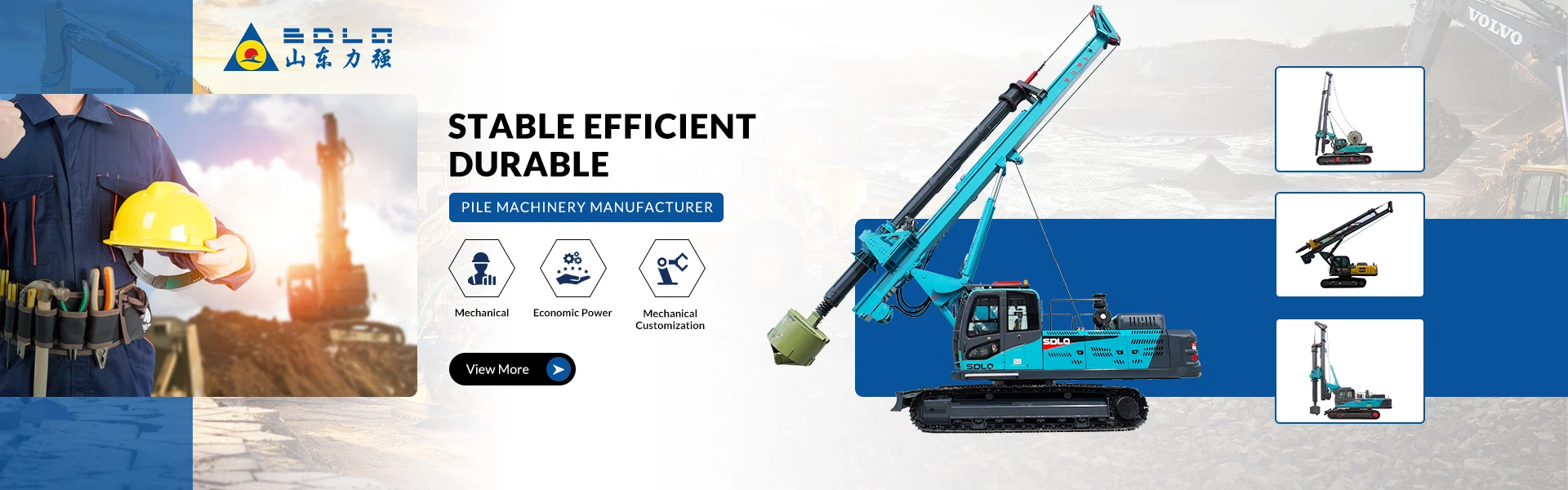
Rotary drilling and reverse circulation are two main methods of hole formation. What are the differences between them? Let's summarize them today.
1. Working Principle of Rotary Drilling Rigs: The drilling rig's own travel function and mast luffing mechanism allow the drill bit to be correctly positioned at the pile location. The mast guides the lowered drill rod, placing the barrel-type drill bit with a bottom valve into the hole. The drilling rig's power head provides torque to the drill rod, and the pressurizing device transmits pressure to the drill rod and drill bit through the pressurizing power head. The drill bit rotates, breaking up the rock and soil, and directly loading it into the drill bit. Then, the drilling rig's lifting device and telescopic drill rod lift the drill bit out of the hole to unload the soil. This cycle repeats continuously, taking and unloading soil until the designed depth is reached.
2. Working Principle of Reverse Circulation Drilling Rigs The drilling rig's rotary mechanism drives the drill rod and drill bit to rotate and break up the rock and soil. Then, a reverse circulation system is used for cuttings removal. During drilling, the drilling mud flows from the mud pit through the wellhead, retaining itself at the bottom of the well. It then carries rock cuttings back to the wellhead through the hollow drill rod and is discharged to the mud pit via a water tap and cuttings removal pipe. After settling, the sediment flows back into the well for further circulation.#drill bit rig#

3. Environmental Impact: Rotary drilling is a dry drilling method or mud-free drilling, using only 1/10 to 1/20 of the mud required for reverse circulation. This results in a cleaner site, less environmental pollution, and lower vibration and noise.
4. Drilling Condition Requirements: Rotary drilling rigs are tracked and can traverse most terrains. Even after rain, they can be drilled after minimal cleaning, demonstrating strong environmental adaptability.
5. Sediment Thickness: Rotary drilling, being a dry drilling method or mud-free drilling, produces less sediment compared to reverse circulation.
6. Hole Formation Speed. Rotary drilling rigs have high rotational torque and can be equipped with different drill bits depending on the geological formation. Their speed is generally 3-5 times that of reverse circulation drilling rigs.#drill bit rig#

7. Economic Benefits. In terms of cost, reverse circulation drilling is cheaper per meter.
8. Differences between Rotary Drilling Rigs and Reverse Circulation Drilling Rigs: Automation Level. Rotary drilling rigs are characterized by self-movement, self-erecting masts, and convenient borehole positioning. They use telescopic drill rods, resulting in less auxiliary time and higher time utilization.#drill bit rig#


