

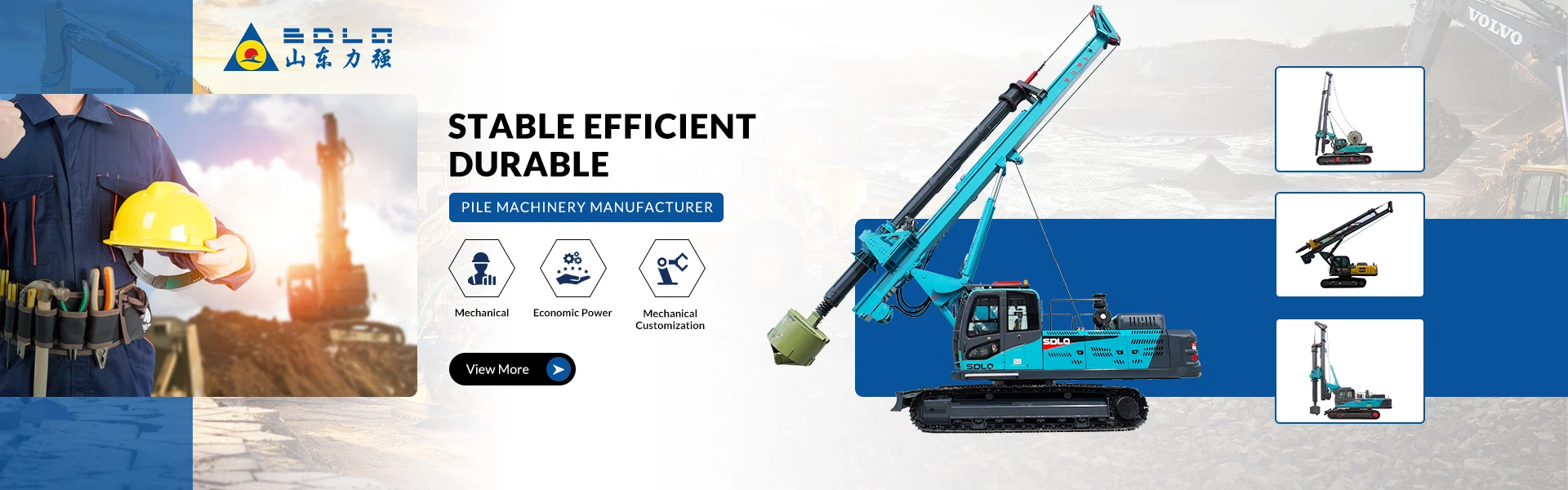
The working principle of a rotary excavator is to use a cylindrical drill bit with a valve at the bottom to rotate and break the rock and soil, and then load it into the drill bucket. Then, the drill bucket is lifted out of the hole by the lifting device and telescopic rod to unload the soil, and smaller gravel blocks can be taken out of the hole. This cycle is repeated, continuously taking and unloading soil until the design depth is reached. The most suitable for clay, sub clay, sand layers, sand and gravel, and rocks with uniaxial compressive strength less than 80mpa.
The main technical performance and characteristics are as follows:
1. The drilling speed is fast, more than 5 times that of ordinary circulating drilling machines, effectively ensuring the progress of the project. The rotary excavator adopts a fully hydraulic design, with high automation and fast working speed. The foundation pile with a diameter of 2.2m and a hole depth of 35m is usually drilled in 2 hours.
2. Easy to move, the rotary drilling rig has a fully hydraulic track type telescopic chassis, which can easily move the drilling rig to the desired position, with good overall stability and good maneuverability.
3. The positioning speed is fast and the positioning accuracy is high. Before drilling, the center of the drill bit is manually directed to align with the pile position, and the corresponding axis coordinates are set by the operator. During the construction process, the operator can use advanced electronic equipment in the cab to accurately achieve alignment and subsequent calibration operations, so that the drilling rig can reach the optimal drilling state. After positioning is completed, the drilling barrel and casing shovel and rotate to excavate the casing foundation pit, which is more time-saving and labor-saving compared to traditional machinery, and has high accuracy.

4. The drilling depth and verticality can be automatically detected and controlled, and can be controlled by an electronic system and displayed in real-time on the screen.
5. The drilling rig comes with its own power and is not limited by the power supply of the site. When working on construction sites with tight power supply, the rotary drilling rig can better demonstrate its superiority.
6. The safety and environmental protection features are prominent, and the rotary drilling operation is flexible and light, with low vibration and noise. In addition, safety protection devices such as height limit and dynamic wall amplitude limit of the main and auxiliary winches, as well as hydraulic control switches in the cab are also installed. During the drilling process, the mud is not circulated, and the mud used can be recycled. The drilling slag can be separated from the mud by lifting the drilling bucket and transported to the designated location by a loader, reducing pollution. The construction site is relatively clean.
7. After drilling, there is less sediment, and the rotary excavator uses static mud to protect the wall. The drilling debris is directly extracted through the rotary bucket, and the amount of sediment is very small.


