

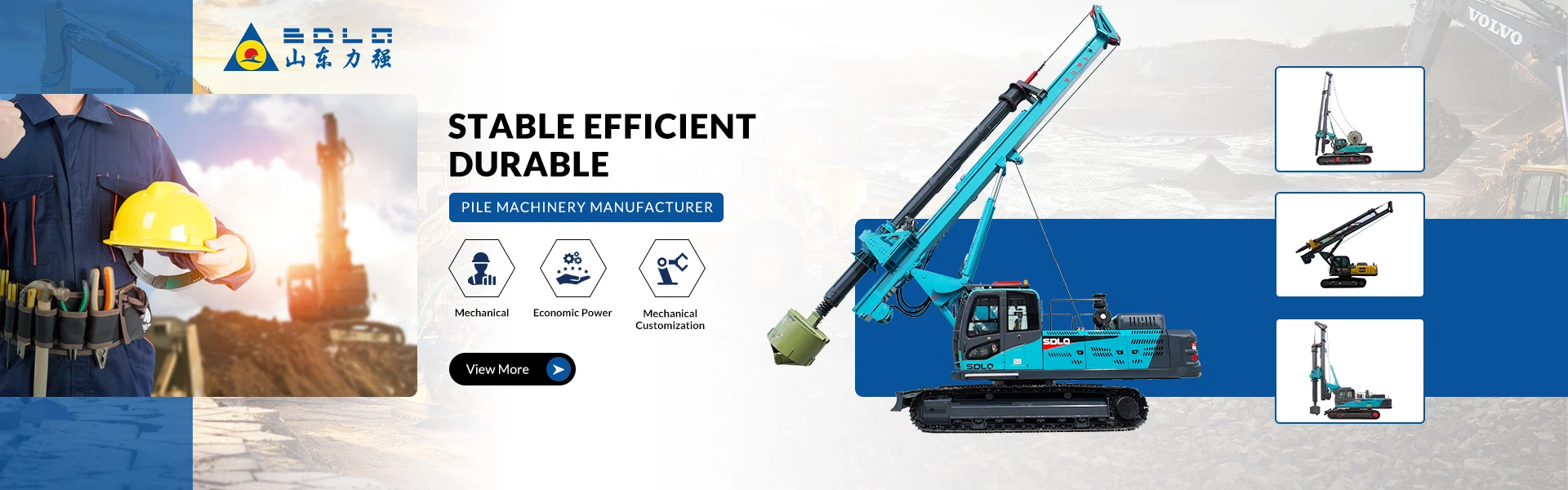
Rotary drilling rigs offer numerous advantages in terms of both technology and equipment, but they also face several limitations. Only by carefully analyzing these unfavorable factors and taking effective measures to overcome them can the advantages of rotary drilling technology be fully realized, leading to greater profits.#drilling drilling machine#
I. Common Problems and Solutions for Rotary Drilling Rigs During Construction
1. Main Winch Rope Breakage. Improper operation during drilling can easily cause the main winch rope to break. Therefore, during drilling, care must be taken to avoid excessive force or looseness in the winch rope winding and unwinding, and to prevent them from biting each other. When lifting the drill bit, the ground's enveloping force on the drill bit should be released first, or the drill string should be pulled out using the hydraulic system. If the steel rope shows signs of wear, it should be replaced promptly to prevent the rope from breaking and causing the drill string to fall off.
2. Wear and Oil Leakage of the Power Head Inner Sleeve. Besides design flaws in the drilling rig, this phenomenon is mainly caused by drilling beyond its design capacity. Therefore, attention should be paid to the design and construction capacity of the rotary drilling rig, and overloading should be avoided.
3. Wear and oil leakage of the inner sleeve of the power head. Besides deficiencies in the drilling rig design, this is mainly caused by drilling beyond the rig's design capacity. Therefore, attention should be paid to the design and construction capacity of the rotary drilling rig, and overloading should be avoided.
4. Drill bit jamming. Drill bit jamming is the most common and dangerous accident in rotary drilling. Therefore, proactive measures must be taken to prevent it during construction. Once an accident occurs, effective measures must be taken to deal with it promptly. (1) In relatively loose sand or quicksand layers, the borehole wall is prone to large-scale collapse, causing the drill bit to become stuck. Before encountering this stratum, countermeasures should be formulated in advance, such as adjusting the mud properties and installing long casings. (2) In clay layers, if the drilling depth is too deep in one go, the borehole wall is prone to narrowing, causing the drill bit to become stuck. Therefore, the drilling depth in this type of stratum should be controlled. For example, when drilling to a depth of 15m or more, the drilling depth in one go should preferably not exceed 40cm. (3) Severe wear of the drill bit's side teeth and lateral teeth makes it impossible to guarantee the hole diameter, and there is no gap between the outer wall of the drill barrel and the hole wall. If drilling is too deep, it is easy to cause the drill bit to get stuck. Therefore, the diameter of the drill barrel should generally be more than 6cm smaller than the hole diameter, and the side teeth and lateral teeth should be lengthened to occupy 2/3 of the length of the drill barrel. At the same time, the side teeth and lateral teeth of the drill bit should be repaired in time after wear during use. (4) Due to mechanical accidents, the drill bit stays at the bottom of the hole for too long, resulting in too much sediment around the drill barrel wall or the hole wall shrinkage, causing the drill bit to get stuck. Therefore, attention should be paid to the timely maintenance and repair of the drilling rig itself, and the mud properties should be adjusted to ensure that there is no sediment at the bottom of the hole for a certain period of time.
5. Treatment measures. The main methods for dealing with stuck drill bits are: (1) Direct lifting method, that is, using a crane or hydraulic jack to directly lift upwards. (2) Drill bit surrounding area clearing method, that is, using reverse circulation or underwater cutting methods to clean the sediment around the drill barrel before lifting. (3) High-pressure jetting method: Two small holes are symmetrically drilled on both sides of the original borehole (the center of the small hole is about 0.5m away from the edge of the drill bit). Then, a nozzle is lowered and aimed at the stuck drill bit with high pressure until both holes are pierced, causing the sediment in the original hole to fall into the small hole, and the stuck drill bit can then be rotated and lifted. (4) Wall protection excavation method: When the stuck drill bit is not deep, the wall is protected with casing, cement, etc., and the sediment is manually excavated and cleaned.
II. Technical advantages of rotary drilling rigs#drilling drilling machine#
1. Advanced equipment performance, high degree of automation, and low labor intensity. Rotary drilling rigs are tracked, fully hydraulic self-propelled drilling rigs, using a complete hydraulic system, and some are also equipped with advanced computer operating systems. To ensure the excellent performance of rotary drilling rigs, most rotary drilling rig manufacturers purchase parts worldwide, such as chassis from Caterpillar (CAT) in the United States, hydraulic systems from Germany, and electrical components from Japan. This can extend the overall life of the rotary drilling rig and prevent its use from being affected by the damage of a single component. Rotary drilling rigs integrate mechanical, electrical, and hydraulic systems, featuring a compact structure, flexible and convenient operation, and a high degree of mechanization and automation. They can move independently within the construction site, erect their own mast, and facilitate quick and easy relocation and borehole alignment. The use of telescopic drill rods saves manpower and time spent adding drill rods, minimizing auxiliary time and maximizing time utilization.
2. Multi-functionality, enabling various drilling methods. Internationally, the design of drilling rigs for large pile holes and foundation construction fully utilizes hydraulic transmission technology and employs modular design methods. Without changing the main unit, a single machine can be used for multiple purposes to meet the adaptability of large construction machinery to different construction methods. In my country, equipment used for dry drilling or non-circulating mud drilling to create piles using short auger bits or buckets is called a rotary drilling rig. In reality, it's a large-scale engineering drilling rig adapted to various construction methods. Besides rotary drilling, it can also perform casing or full-casing drilling, be equipped with a grab bucket for diaphragm wall construction, use dual-power heads for pile wall cutting, and perform long auger drilling (CFA method), truly achieving multi-purpose functionality.
3. High drilling efficiency. Rotary drilling rigs can be configured with different drill bits depending on the geological conditions. In cohesive soil layers, long drill barrels can be used to accelerate drilling speed; for strata with high sand and gravel content, short drill barrels can be used with mud wall support to control drilling speed; for strata containing boulders, erratics, and harder rock, long and short auger bits can be used for loosening, and then the drill barrel can be replaced to continue drilling. Compared to conventional drilling rigs, rotary drilling rigs have a larger rotation torque and can automatically adjust according to geological conditions. High drilling pressure, easily controlled. Furthermore, because rotary drilling bits extract soil and rock directly from the borehole, their drilling speed is extremely high. Generally, drilling speeds can reach 10 m/h in soil and sand layers, and 4-6 m/h in clay layers, which is 3-5 times, or even higher, than ordinary rotary drilling.
4. Low environmental pollution. Rotary drilling is a dry or non-circulating mud drilling method, using only 1/10 to 1/20 of the mud volume used in forward and reverse circulation drilling. Therefore, the construction site is clean, and environmental pollution is minimal. Rotary drilling also produces less vibration and noise.
5. High-quality pile formation. Rotary drilling causes minimal disturbance to the strata, resulting in a thin mud cake on the borehole wall and a rough borehole wall, which increases the side friction of the pile and ensures the design bearing capacity of the pile foundation. Less sediment at the bottom of the borehole facilitates cleaning and improves the bearing capacity of the pile end.
III. Restrictive Factors on the Promotion and Application of Rotary Drilling Technology
1. High Equipment Price. Typically, the diameter of bored piles is 1.2-1.5m. When purchasing equipment, a safety margin is usually considered, and the construction capacity of the purchased rotary drilling rig needs to be slightly larger. Therefore, the most commonly used rotary drilling rigs currently have a drilling diameter between 1.5-2m. The price of such a rig is over 4 million yuan. If the drilling diameter is larger, the price of a single rig plus accessories can reach tens of millions of yuan. For most construction companies, especially the vast majority of geological teams engaged in pile foundation construction, investing several million or even tens of millions of yuan in equipment at once is difficult. Firstly, they simply lack the funds for such a large equipment purchase. Secondly, from the perspective of the current management system, even if they had the ability to purchase this advanced construction equipment, the company's leadership would consider various factors and not easily make the purchase.
2. Restriction by Project Scope. Because rotary drilling rigs are expensive and have high operating costs, certain requirements are placed on projects using them, unlike traditional pile foundation construction, which only requires suitable geological conditions and has no specific requirements for the project itself. Firstly, rotary drilling rig projects require large-scale operations and open, level sites. Rotary drilling rigs are heavy, typically weighing tens or even hundreds of tons. If a single project is small, relocation costs are high, and the time commitment is long, resulting in low time utilization, all of which hinder the rotary drilling rig from realizing its advantages. Therefore, only when a single project is large enough to allow the rotary drilling rig to operate on the same site for an extended period, reducing relocation costs and maximizing time utilization, can its advantages be fully realized. Besides the large scale of individual projects, the total workload required to maintain the normal operation of a rotary drilling rig also has certain requirements. Currently, it generally needs to achieve an annual drilling volume of over 20,000 linear meters and a project cost of over 5 million yuan to fully realize its advantages. Meanwhile, due to the weight and size of the equipment, the construction site must be relatively open, flat, and have a certain degree of hardness to prevent the drilling rig from sinking. Construction cannot be carried out on loose, muddy, or uncompacted ground. Secondly, projects using rotary drilling rigs require high profit margins. Because rotary drilling equipment is expensive and has high operating costs, it is only worthwhile to construct a project if it achieves a certain profit margin. Based on engineering experience, generally, rotary drilling rigs are only used when the gross profit margin of a project reaches 50% or higher.
3. The limitations of the geological formation. Rotary drilling is suitable for soil layers, sand layers, and relatively loose gravel layers with small particle sizes. It performs best in cohesive soil layers such as silty clay and clayey silt. Construction is difficult in hard rock layers, dense gravel layers, and boulder layers, and accidents inside the borehole and mechanical failures are more likely to occur, negating the advantages of rotary drilling.
4. High operating costs. The high price of the equipment naturally leads to high operating costs. According to drilling rig manufacturers and user feedback, the full-load normal operating life of a rotary drilling rig is 6300 hours. After this lifespan, some components require replacement or repair, especially the winch system, hydraulic system main pump, power head, and drill rod. These components are relatively expensive, and replacement time is lengthy. This significantly increases the operating costs of rotary drilling rigs in actual use, consequently raising the construction costs of pile foundations. Currently, due to intense and unregulated competition in the pile foundation market, many projects are subcontracted multiple times before reaching construction companies, resulting in low prices and minimal profit margins. While using rotary drilling rigs offers high efficiency and good project quality, profits are low or even negative. This is the main reason why many construction companies leave rotary drilling rigs idle, continuing to use traditional, relatively outdated construction methods.
Rotary drilling technology is one of the future directions of borehole grouting technology. Compared with traditional impact or rotary drilling and mud circulation wall protection technology, rotary drilling has many advantages, but it also has many limiting factors. We must give full play to its strengths and discard its weaknesses in order to better leverage the advantages of rotary drilling technology and create more wealth for us!#drilling drilling machine#


