

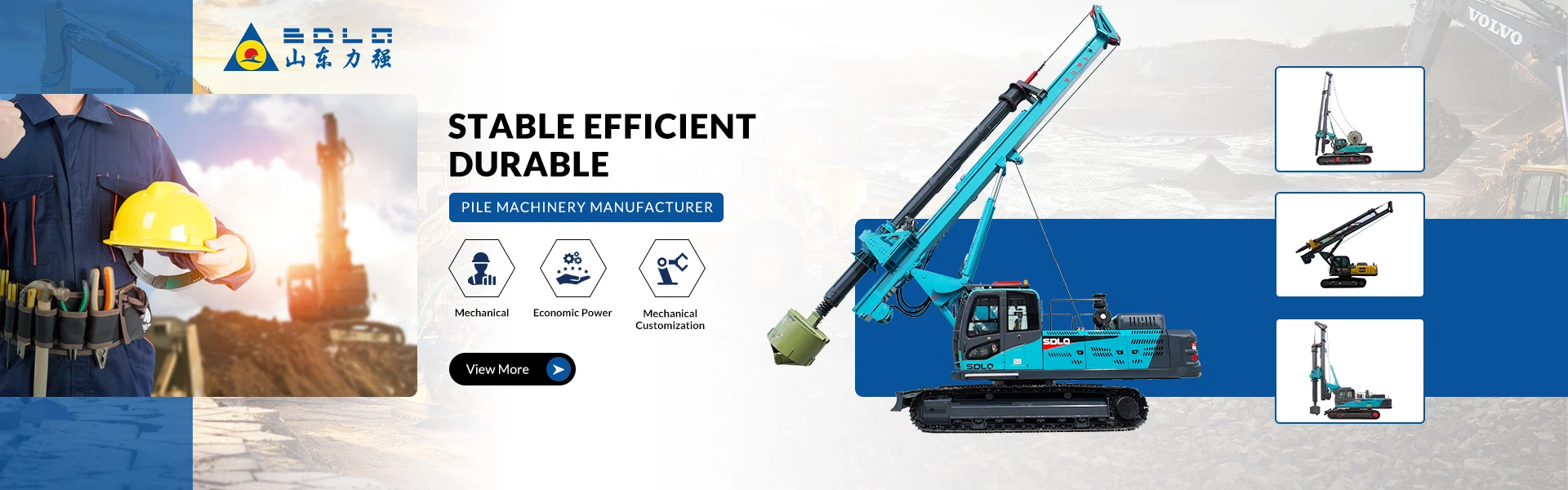
The working principle of a rotary drilling rig mainly involves rotary drilling technology. The following is a detailed explanation of its working principle:
I. Power Transmission#heavy drill machine#
The engine system of the rotary drilling rig provides the operating power, which is transmitted to the power head through a hydraulic system or devices such as cylinders and hydraulic motors.
The power head, as a key component, is responsible for receiving and converting the power into rotational torque.
II. Rotation of the Drill Rod and Drill Bit
Torque Transmission by the Drill Rod:
When the power head rotates, it drives the drill rod to rotate via a chain or hydraulic system. The drill rod, acting as the intermediary connecting the power head and the drill bit, is responsible for transmitting the rotational torque to the drill bit.
Drill Bit Rotation and Drilling:
The drill bit is mounted at the lower end of the drill rod and rotates along with the drill rod.
The drill bit uses appropriate drilling tools, such as single-layer shell drills, double-layer shell drills, and skip drills, to adapt to different geological conditions.
The drill bit, through rotation and propulsion, strips soil from the drilled layer and loads it into the drill bit.
III. Drilling and Sampling
Drilling into Soil Layers:
Under the influence of rotational torque, the drill bit continuously rotates and advances, breaking up the soil and filling it into the drill bit. As the drill bit penetrates deeper, the soil is continuously stripped away and removed.
Sampling and Core Taking:
For geological exploration work requiring sampling, the drill bit can further drill into the soil layers to retrieve soil samples or rock cores. These samples can be used for geological analysis, soil testing, and other purposes.

IV. Circulation Flushing and Consolidation
Circulation Flushing:#heavy drill machine#
To prevent the drill bit from getting stuck or obstructed, the rotary drilling rig performs circulation flushing during drilling.
Water or mud is injected into the borehole through the drill rod to reduce frictional resistance between soil particles and flush away impurities in the soil layer.
Consolidation:
In some cases, it is necessary to drill and immediately fill loose soil to increase soil stability. The rotary drilling rig can achieve borehole consolidation by injecting materials such as cement grout or reinforcing steel.
V. Unloading and Circulation Operation
Unloading Process:
Once the drill bit is full of soil, the rotary drilling rig lifts the drill bit to the ground using a lifting device. Then, the soil is unloaded from the drill bit by rotating or tilting.
Circulation Operation:
After unloading, the drill bit is returned to the drilling position, and the next work cycle begins.
In this way, the rotary drilling rig can continuously drill, sample, unload, and circulate until the designed depth is reached or the work task is completed.
In summary, the working principle of a rotary drilling rig is a complex and intricate process, involving multiple stages such as power transmission, rotation of the drill rod and drill bit, drilling and sampling, circulation flushing and consolidation, and unloading and recirculation. These stages coordinate and work together, enabling rotary drilling rigs to efficiently complete various tasks in fields such as geological exploration, foundation construction, geotechnical engineering, and environmental engineering.#heavy drill machine#


