

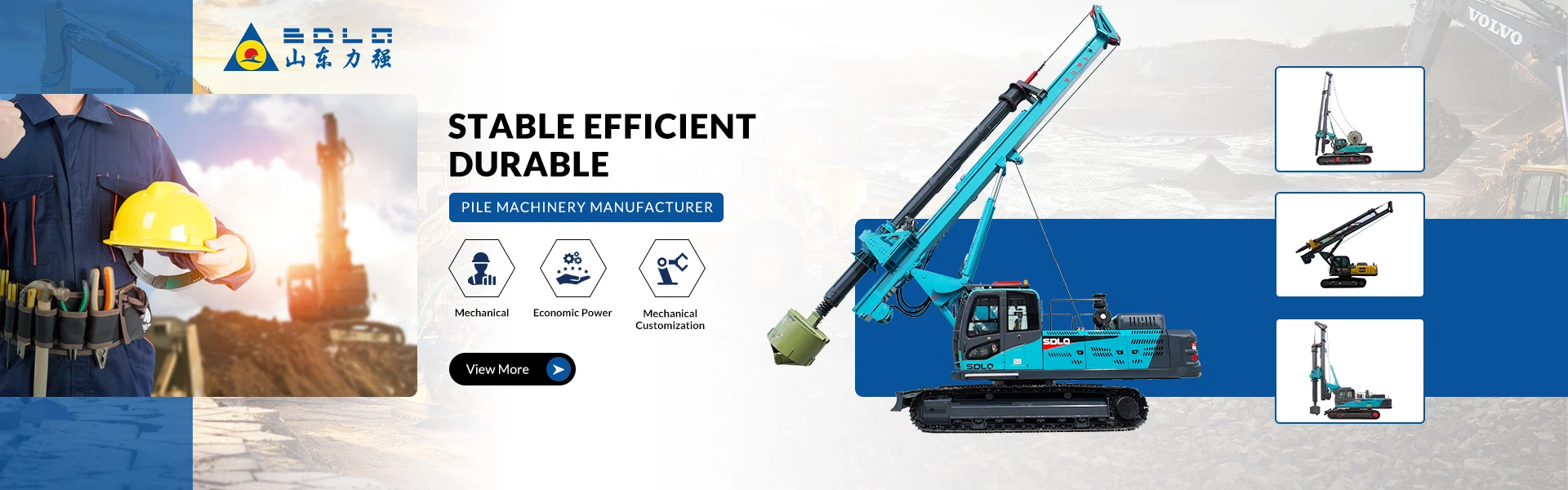
Rotary Drilling Rig Hole Formation Characteristics# cfa pile rig#
Compared to traditional bored pile rigs, rotary drilling rigs exhibit significant advantages in hole formation. These advantages are mainly reflected in the following aspects:
High Efficiency: Rotary drilling rigs utilize advanced rotation and digging technology, enabling rapid hole formation and significantly improving construction efficiency.
High Precision: Their unique drilling trajectory control system ensures high accuracy in hole formation, reducing errors.
Strong Applicability: Rotary drilling rigs are suitable for various soil conditions, including soft soil, hard soil, and sandy soil, offering wide applicability.
Environmentally Friendly and Energy-Saving: Utilizing advanced engine technology and construction processes reduces noise and pollution during construction, while also saving energy.
However, the rotary drilling rig hole formation process also has certain limitations that need to be considered in practical applications.
Rapid Hole Formation: With its highly efficient rotation and digging technology, the rotary drilling rig achieves a hole formation speed far exceeding that of ordinary circulating drilling rigs, reaching more than 5 times faster, thus significantly ensuring project progress. Its telescopic drill rod design allows for even faster drill lifting. Taking a 1-meter diameter, approximately 17-meter deep foundation pile as an example, drilling can be completed in just about one hour. Furthermore, rotary drilling rigs possess excellent geological adaptability and a wide range of applications.
2. Convenient Relocation# cfa pile rig#
The rotary drilling rig employs a hydraulic tracked telescopic chassis design, allowing it to be easily moved to a designated location. Compared to traditional circulating drilling rigs, the relocation process is much simpler. This design also ensures the stability of the entire machine and excellent maneuverability during relocation.
3. Fast and Precise Positioning
Before drilling, the operator simply guides the drill bit center to align with the pile position, and then the robotic arm sets the corresponding coordinates as the axis of rotation. During construction, the operator in the cab can easily achieve precise positioning control through advanced electronic equipment, ensuring the drilling rig is always in optimal drilling condition.
4. Automatic Detection and Control of Drilling Depth and Verticality
Thanks to the high degree of automation of the drilling rig, the drilling depth and verticality can be monitored in real time by an electronic system and displayed intuitively on the screen.
5. Superior Safety and Environmental Performance
This drilling rig utilizes a fully hydraulic transmission system. Leveling and movement are achieved via hydraulic motors or cylinders, providing excellent overload protection to ensure smooth and safe operation. It is also flexible and easy to operate, with minimal vibration and noise, significantly reducing the operator's workload. Furthermore, the rig is equipped with comprehensive safety protection devices, including height and boom amplitude limits for the main and auxiliary winches, and hydraulic switches in the operator's cab, ensuring civilized construction and safe production. During drilling, there is no need for circulating mud; the mud can be recycled. Simultaneously, drill cuttings are separated from the mud during the lifting of the rotary drilling bucket and can be removed, effectively reducing pollution and maintaining a clean and tidy construction site.
6. Efficient Sludge Management
After drilling, the rotary drilling rig achieves static mud wall protection, allowing drill cuttings to be efficiently removed via the rotary drilling bucket, thus significantly reducing the amount of sludge. In contrast, other drilling rigs typically use mud circulation for sludge removal, resulting in two to three meters of sludge buildup. This advantage not only improves drilling quality but also saves time and costs for subsequent construction.
7. Significantly Improved Bearing Capacity of Rotary Drilling Piles
The unique drilling process of rotary drilling rigs allows the drill bit to move up and down multiple times, roughening the borehole wall and effectively reducing the occurrence of diameter reduction. Compared to traditional bored piles, the bearing capacity of rotary drilling piles is significantly improved, thus ensuring the construction quality of the load-bearing piles.
V. Disadvantages of Rotary Drilling Rigs
Although rotary drilling rigs perform excellently in improving bearing capacity, they also have some limitations that cannot be ignored, including:
1. Limited Adaptability to Soil Layers
Rotary drilling rigs are most effective in soil layers, sand layers, and relatively loose gravel layers with small particle sizes, especially in cohesive soil layers where drilling efficiency is significantly high. However, when facing complex geological conditions such as hard rock layers, dense gravel layers, or boulder layers, the construction difficulty increases significantly, which may lead to accidents inside the borehole and mechanical failures, thus preventing the full realization of the technical advantages of rotary drilling rigs.
2. High Purchase Costs
Currently, the price of domestically produced rotary drilling rigs is approximately 4 to 5 million yuan, while imported rigs exceed 6 million yuan. Such a large upfront investment poses a significant challenge for many foundation construction companies.
3. High Maintenance Costs and Time Delays
Under full load conditions, the normal operating life of a rotary drilling rig typically exceeds 6,000 hours. However, once this lifespan is exceeded, some critical components, such as the hydraulic system main pump, power head, and drill rods and tools, may require replacement or repair. These repairs are not only costly but also often time-consuming. During the construction of the Qiaoxi support piles, the rotary drilling rig frequently malfunctioned due to the drill rods exceeding their normal operating lifespan, which not only affected the construction progress but also increased maintenance costs. VI. Acceptance Documents for Rotary Drilled Piles
According to the standard of the *Technical Specification for Building Piles* JGJ94–2008, the acceptance process for rotary drilled piles is as follows: If the design elevation of the pile top is close to the construction site elevation, the pile acceptance should be carried out after construction is completed; if the design elevation of the pile top is lower than the construction site elevation, acceptance should be carried out after excavation to the design elevation. In addition, the following documents must be collected and verified for pile acceptance:
VI. Acceptance Documents for Rotary Drilled Piles# cfa pile rig#
The acceptance of rotary drilled piles must be carried out in accordance with the standard of the *Technical Specification for Building Piles* JGJ94–2008. During the acceptance process, the following key documents should be collected and verified:
Geotechnical investigation report, which details the soil conditions and provides a reference for construction.
Pile foundation construction drawings and minutes of drawing review meetings, ensuring that the construction process is consistent with the design scheme.
Design change orders and material substitution notices, recording possible adjustments and changes during construction.
Approved construction organization design and construction plan, as well as change orders in progress, providing guidance for the construction process.
The following documents are required:
Pile location surveying and layout diagrams, including engineering pile location line verification and certification forms, to ensure accurate pile locations.
Quality certificates and quality appraisal certificates for raw materials, guaranteeing that the quality of materials used meets requirements.
Construction records and concealed works acceptance documents, recording key information during construction and the acceptance status of concealed works.
Pile quality inspection reports and single pile bearing capacity test reports, assessing the quality and bearing capacity of the piles.
As-built plan of the foundation pit excavated to the design elevation and pile top elevation diagram, visually demonstrating the construction results of the foundation piles.
Furthermore, rotary drilling rigs, as a crucial component of drilling equipment, involve numerous and complex construction processes. Therefore, during construction, construction and supervision personnel must possess a rigorous work attitude, a high sense of responsibility, excellent technical skills, and rich experience in on-site handling. Especially in building foundation construction, strengthened construction management is necessary to ensure that the pile quality meets the expected requirements.# cfa pile rig#


