

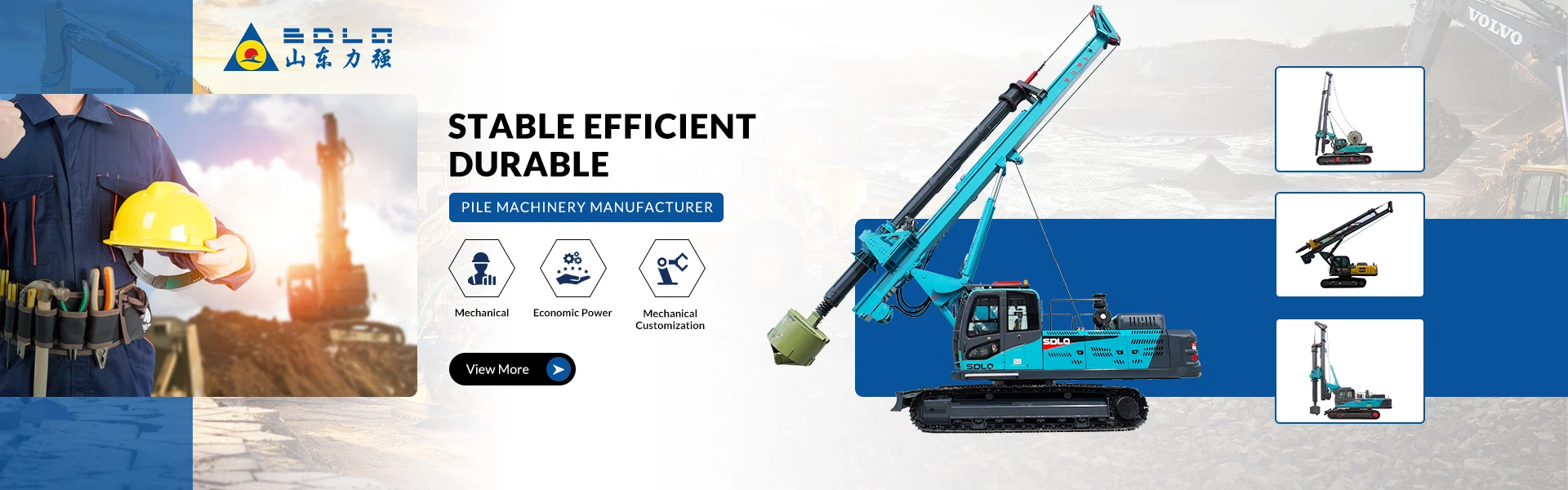
1. Definition and Function of Rotary Drilling Rigs#cfa rig#
Rotary drilling rigs, indispensable heavy equipment in foundation engineering, are highly regarded for their high efficiency and multi-functionality. They are widely used in pile foundation construction, playing a crucial role, especially in foundation construction and civil engineering. Despite their complex structure, they can be summarized into the following core components:
**Main Chassis:** The chassis of a rotary drilling rig is typically tracked, designed to provide excellent stability and adaptability to various terrains. The chassis is equipped with a hydraulic drive system to support the equipment's movement and rotation.
**Power Head:** As the core component of the rotary drilling rig, the power head is primarily responsible for driving the drill rod to rotate. It is usually powered by a hydraulic motor, providing high torque output to meet drilling requirements under different geological conditions.
**Drill Rod and Drill Strings:** The drill rod, as the connecting component between the power head and the drill string, possesses sufficient rigidity and a certain length to allow for flexible splicing or disassembly according to actual construction needs. Drilling tools, as excavation tools that come into direct contact with the ground, are used to break and excavate soil or rock. Common types include drill buckets, auger bits, and core drill bits.
Main Winch: The main winch plays a crucial role in drilling. It is primarily responsible for raising and lowering the drill string and drill rod, while applying the necessary pressure to the drill rod to propel the drill. It is also used to remove soil or rock from the borehole, ensuring the smooth progress of drilling operations.
Auxiliary Winch: The auxiliary winch is mainly used to assist in raising other heavy objects or equipment, such as providing necessary support during the installation and dismantling of drill strings and drill rods.
Mast System: As a key structure supporting the drill rod and drill string, the mast is typically designed to be telescopic to accommodate boreholes of different depths. The pulley system on the mast facilitates the raising and lowering of the drill string.
**Slewing Platform:** Located between the chassis and the superstructure, this platform allows the superstructure, including the power head and mast, to rotate 360 degrees, significantly improving construction flexibility.
**Hydraulic System:** As the core power transmission system of the rotary drilling rig, the hydraulic system controls the movement of key components such as the power head, winch, and mast. It mainly consists of hydraulic pumps, hydraulic cylinders, and hydraulic motors, ensuring efficient and stable operation.
**Operator's Cab and Control System:** The operator's cab is the workplace, equipped with joysticks, displays, and other control devices. The control system, typically an electro-hydraulic control system, integrates automation and monitoring functions, aiming to improve operational accuracy and safety.#cfa rig#
**Counterweight System:** To maintain the equipment's balance, rotary drilling rigs are usually equipped with a counterweight system, generally located at the rear. Its function is to provide necessary stability during operation.
The synergistic effect of these components enables rotary drilling rigs to perform drilling operations efficiently and stably in various complex geological environments. Next, we will explore the major rotary drilling rig manufacturers worldwide and their characteristics. 2. Soilmec S.p.A.
Country: Italy
Introduction: Soilmec is a leading global manufacturer of foundation engineering equipment, specializing in rotary drilling rigs, diaphragm wall equipment, and other foundation construction machinery. Its products are renowned for their superior performance and reliability, and are widely used in large-scale construction projects worldwide.
3. Casagrande Group
Country: Italy
Introduction: As a well-known Italian manufacturer of foundation construction machinery, Casagrande focuses on the research and development and production of rotary drilling rigs. Its equipment enjoys a high reputation in deep foundation and underground engineering and is widely used globally.
4. Liebherr Group
Country: Germany
Introduction: Liebherr, a world-renowned construction machinery manufacturer, is known for its high-quality rotary drilling rigs. Product features include high-quality power systems, intelligent control technology, and excellent geological adaptability.
5. SANY Heavy Industry Co., Ltd.
Country: China
Introduction: SANY Heavy Industry, a leading Chinese construction machinery manufacturer, holds a significant position in the global rotary drilling rig market. Its products are highly praised by customers worldwide for their high cost-performance ratio, superior performance, and wide range of applications.
6. XCMG Group
Country: China
Introduction: XCMG Group, one of China's largest construction machinery manufacturers, offers a variety of rotary drilling rig models to meet the needs of different foundation construction projects. Its products stand out for their durability and technological innovation.
7. Zoomlion Co., Ltd.
Country: China
Introduction: Zoomlion, a large Chinese construction machinery manufacturer, offers a diverse range of rotary drilling rigs to meet the needs of various complex geological and construction conditions. Its products cover a wide range of models and are known for their stable and reliable performance.
These companies all enjoy significant influence in the global rotary drilling rig field, offering equipment of various specifications and models to meet the diverse construction needs and geological challenges of different customers. Next, we will outline the development history of rotary drilling rigs and their key role in the advancement of foundation engineering technology. 1. Early Development Stage (Before the 1970s)
Background: Before the 1970s, foundation engineering mainly relied on traditional drilling equipment, such as impact drills and rotary drills. These devices proved inefficient and demanding in terms of operating environment when facing complex geological conditions and deep drilling.
Demand: With the acceleration of urbanization and the increase in large-scale infrastructure projects, the demand for more efficient and precise drilling equipment gradually emerged.
2. The Birth of Rotary Drilling Rigs (1970s)
Innovation: In the 1970s, Bauer of Germany pioneered the development of the first rotary drilling rig. This equipment combined the best of rotary drilling and rotary excavation technologies, enabling efficient drilling operations under various geological conditions, significantly improving construction efficiency and accuracy.
Features: Early rotary drilling rigs were equipped with hydraulic systems, providing greater torque and pressure to adapt to various complex geological conditions. Their emergence undoubtedly marked the beginning of a new era of mechanization in foundation engineering construction.
3. Technological Advancements and Global Applications (1980s-1990s)
With the continuous development of hydraulic technology, materials engineering, and automated control systems, the performance of rotary drilling rigs has been significantly improved. Countries around the world introduced and improved rotary drilling technology, thus promoting the widespread application of rotary drilling rigs globally.
During this period, rotary drilling rigs played a crucial role in the construction of large-scale infrastructure such as building foundations, bridge pile foundations, and port terminals, gradually becoming an indispensable piece of equipment in foundation engineering.
4. Intelligent and Modern Development (21st Century)
In the 21st century, advancements in electronic control and sensor technologies have enabled rotary drilling rigs to achieve intelligent upgrades. Modern rotary drilling rigs are equipped with advanced control systems that can monitor and adjust drilling parameters in real time, thereby improving construction accuracy and safety.
Simultaneously, with the diversification of geological conditions and construction needs, the models and functions of rotary drilling rigs have become increasingly diversified, thus meeting various needs from small-scale urban construction to large-scale infrastructure projects.
5. Environmental Protection and Energy Conservation Technology Innovation (Late 21st Century)
With increasing global environmental awareness, rotary drilling rigs have begun to focus on developing energy-saving and emission-reduction technologies. The application of low-emission engines and new energy power systems is gradually increasing to adapt to increasingly stringent environmental regulations.
Looking to the future, rotary drilling rigs will further develop towards automation, intelligence, and green environmental protection to cope with more complex construction environments and higher construction standards.
1. High Efficiency
With its powerful drilling capabilities, rotary drilling rigs can complete the construction of large-diameter, deep piles in a short time, significantly improving construction efficiency. Its continuous operation also greatly reduces non-operation time, further improving work efficiency.
2. Strong Adaptability
Whether it's hard rock, pebble layers, clay, or sand, rotary drilling rigs can easily handle them, maintaining high drilling efficiency. Furthermore, its multi-functionality allows it to meet different construction needs, such as being equipped with auger bits, tubular drills, and sand-dredging bits.
3. High Construction Quality#cfa rig#
Modern rotary drilling rigs are equipped with advanced control systems that precisely control drilling depth, borehole verticality, and diameter, ensuring high construction quality. Simultaneously, they minimize disturbance to the surrounding soil during drilling, resulting in excellent hole formation and providing strong support for subsequent pile foundation construction.
4. Environmental Friendliness
Rotary drilling rigs operate with low noise, making them suitable for noise-sensitive areas such as urban areas. Compared to traditional impact drills, they generate less dust and vibration, effectively reducing their impact on the surrounding environment.
5. Safety
Rotary drilling rigs are equipped with multiple safety protection devices and automated control systems that monitor various parameters during drilling in real time, reducing operational risks. Their stable structural design, low center of gravity, and strong anti-overturning capabilities make the construction process safer and more reliable.
6. Flexibility
Rotary drilling rigs are mounted on tracked chassis, providing excellent mobility and allowing for flexible movement on construction sites to adapt to different working faces. Their ease of operation also reduces the technical requirements for operators.
7. Economic Efficiency: The high efficiency and high-quality construction of rotary drilling rigs reduce project construction time and labor costs, resulting in excellent overall economic efficiency. Furthermore, their robust structural design, long service life, and relatively low maintenance costs contribute to their high cost-effectiveness.
In conclusion, rotary drilling rigs demonstrate significant advantages in multiple aspects, making them an indispensable piece of equipment in modern foundation engineering construction.#cfa rig#


